
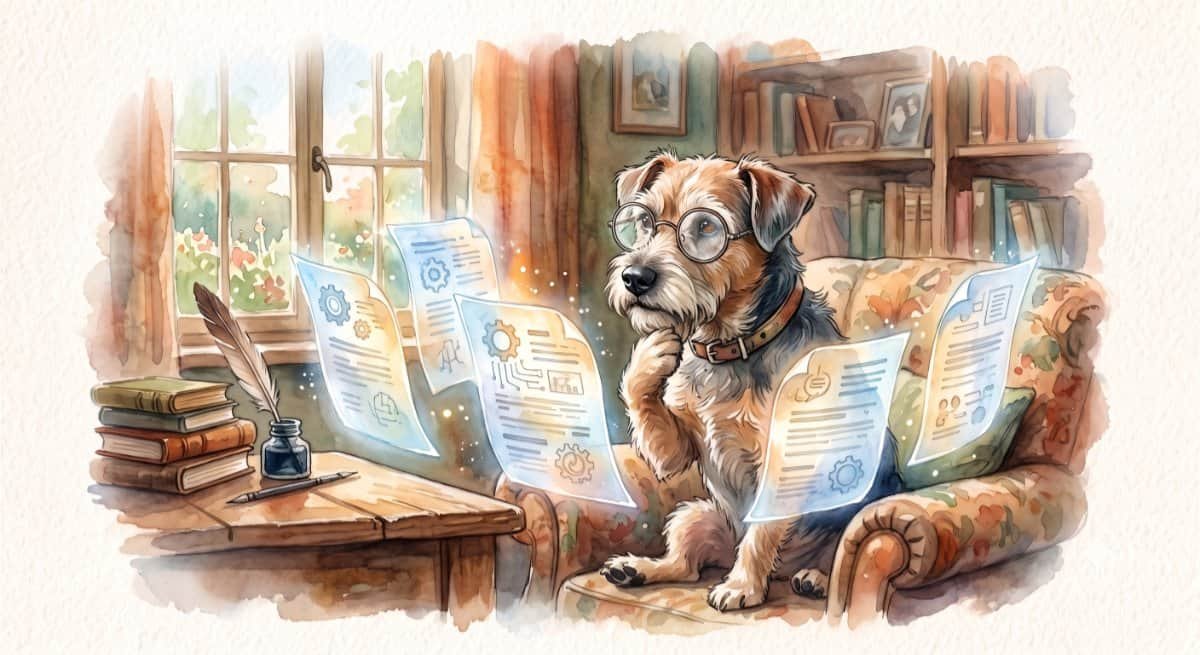
I recently asked five AI models to wander around OldDogZeroTricks and each write one original post. I didn’t give them topics, lessons, or specific chapters of my life to cover. I simply wanted to see what they thought this blog was for, and whether they could write something that would genuinely serve you as a reader.
Claude, Gemini, ChatGPT, Grok, and Perplexity all accepted the challenge.
The five resulting posts are entirely AI‑written. I didn’t change their wording at all, although I did add some internal links afterwards where they mentioned subjects I’d already written about, so you can follow those threads if you’d like.
This was never meant to decide which Large Language Model (LLM) is “best.”
I was interested in two questions:
- Does AI understand OldDogZeroTricks well enough to respect its mission?
- Do their posts offer real value to someone visiting the blog?
Table of Contents
To make that easier to compare, I looked at three things for each post:
Mission fit – How well it reflects what OldDogZeroTricks is trying to do.
Reader value – Whether it gives a visitor something worth thinking about or trying.
Assumptions / overreach (Low / Moderate / High) – How much it invents, assumes, or speaks too confidently about a life it hasn’t lived.
Here’s how each post fared..
Claude: “The Things I Hope I Stay Bad At”
Claude’s post builds itself around one idea: not every enjoyable activity has to become a serious pursuit. It uses my long‑term Japanese study, older‑gamer status, and the motorcycle I still don’t own as examples of hobbies and interests that can stay imperfect without losing their value.
Mission fit
Claude clearly sees OldDogZeroTricks as a place that questions improvement as obligation. It understands that the blog often pushes back against the pressure to turn every hobby into a project, every interest into a performance, and each season of life into a visible upgrade.
The phrase tying the post together is “the improvement tax” – the sense that enjoyment alone is no longer enough, and we must justify our hobbies by getting better at them. That’s a very on‑mission subject here, especially for middle-aged readers who’ve spent years measuring themselves against goals, achievements, and progress charts.
Reader value
The “improvement tax” lens is actually useful. If you’re someone who feels guilty for staying a casual player, amateur guitarist, slow language learner, or ordinary gardener, the post gives you a way to question that pressure.
Claude doesn’t try to cover my entire life. It picks three concrete examples and develops one clear thought around them: that staying a beginner on purpose can protect happiness and lower expectations in a healthy way. For many visitors, that’s enough to walk away with a different way of looking at their own hobbies.
Assumptions and overreach
Near the end, Claude writes, “So I’m going to keep being bad at Japanese.” That’s where it goes a little beyond what I’d say.
I appreciate the attempt to release pressure, but there’s a difference between refusing to punish yourself for slow progress and deciding you want to remain bad at something. I don’t want to train myself – or you – to expect less than we might reasonably be capable of, even in midlife. In this case, the AI takes a true tension (imperfect progress) and finishes the philosophy for me more definitively than I would.
Dog-bones:
Mission fit: 4.5 / 5 

Reader value: 4 / 5 
Overreach: Moderate
Out of the five, Claude produced the post I could most easily imagine accepting as a focused guest article. It feels close to the blog’s character and gives readers a clear, modest gift: permission to enjoy some things without turning them into proof.
Gemini: “The Secret Joy of Being the Slowest Guy in the Lobby”
Gemini’s post goes straight for one of the more playful corners of the site: being an older gamer in modern multiplayer lobbies. It opens with dropping into a match, getting demolished within seconds by teenagers with better reflexes and map knowledge, and then spectating with coffee while the chaos continues.
Mission fit
Gemini understands that OldDogZeroTricks often questions the pressure to keep up – not just in games, but in work, money, fitness, technology, relationships, and expectations we place on ourselves.
The bigger message is that life can become more enjoyable when you stop treating it as a constant tournament. The image of letting faster players race for the high ground while you wander the edges of the map is a strong metaphor for stepping out of the race and choosing a slower, quieter path that still feels worthwhile.
Reader value
If you’re an older gamer, or simply someone exhausted by treating every Tuesday like an esports event, the post offers a practical invitation: you don’t have to play at full speed to have a good time.
Gemini uses gaming language with confidence – bad loot, frame rates, distant areas no one visits – and builds vivid scenes that make the idea memorable. Even if you never touch a controller or mouse and keyboard, the “slowest in the lobby” image might stick as a way to think about your pace in work or life.
Assumptions and overreach
One line caused a pause: “I actually hated keeping up.” That’s too absolute.
There are parts of competition and improvement I respect and enjoy. I don’t want to step into a binary where either you’re racing frantically or you’ve given up on progress altogether. Gemini selects the calmer side of me and presents it as though that side has already won the argument. In reality, many of us still want peace and progress on the same day.
There’s also a structural overreach: almost everything in the post is made to fit the gaming metaphor. Life becomes a lobby, younger people become opponents, work feels like a tournament, slowing down becomes walking the perimeter. It works, but it makes the piece feel more constructed than lived, which is one of the clearer marks of AI writing.
Dog-bones:
Mission fit: 4 / 5
Reader value: 3.5 / 5
Overreach: Moderate
Gemini wrote the funniest of the five posts and probably the easiest one to skim. It grasps a real part of the blog’s mission – questioning the race – and turns it into an entertaining metaphor. At the same time, it simplifies the mix of wanting rest and still caring about doing things well.

ChatGPT: “The Life You Keep Choosing”
ChatGPT’s post is the longest of the five, just over 2,000 words. It argues that our real lives are revealed less by what we say we want and more by what we repeatedly choose: the places we keep returning, the responsibilities we continue to carry, and the dreams we still check on even after declaring them “over.”
Mission fit
In terms of breadth, ChatGPT recognises the widest range of OldDogZeroTricks themes: staying or leaving, ordinary work, faith without clear answers, relationships and loyalty, dreams, solitude, coffee, Japan, and the possibility that a smaller‑looking life can feel more honest than an impressive one.
That central tension – between the life that fits and the one that impresses – is very close to the centre of the blog. For many midlife readers, the question “Which life do my repeated choices point towards?” is more realistic than “What should I do with the rest of my life?”
Reader value
The two main questions it offers are useful:
- “What am I already choosing?”
- “Do I still want to choose it?”
Those are simple enough to take into a commute, a farming day, or a quiet evening. They leave room for both acceptance and change, and they avoid the drama of full reinvention.
ChatGPT also separates choices made from fear, duty, habit, and love. That mirrors a lot of the self‑examination many of us are doing in midlife. For readers, this piece is likely to spark reflection about where their daily decisions are subtly steering their lives.
Assumptions and overreach
The main weakness is length and neatness. ChatGPT doesn’t fully trust its own central idea; it keeps adding more sections, more qualifications, and more polished conclusions, until the structure starts to feel highly arranged. The many short, single‑sentence paragraphs give the post breathing room, but at over 2,000 words it starts to look more like a curated reflective essay, or a poem, than a typical early‑morning blog post.
It also frequently makes me sound as though I’ve reached conclusions I’m still testing. Real choices often contain fear, duty, habit, affection, and desire all at once. The article knows this in theory, but its tidy structure makes the mess look more manageable than it usually feels. That’s where the AI nudges things into a calm framework I wouldn’t necessarily claim in my own words.
On the other hand, ChatGPT is the only one that steps outside itself and questions its right to write: “Maybe it can act like a mirror with very good grammar and no actual skin in the game.” That line captures the entire experiment more clearly than anything I could have written.
Dog-bones:
Mission fit: 4.5 / 5
Reader value: 4 / 5
Overreach: Moderate
ChatGPT understood the largest number of recurring themes and produced the most self‑aware contribution. It also shows how easily “very good grammar” can turn complicated tensions into something smoother than they actually are.

Grok: “The Unglamorous Things That Actually Hold You Together”
Grok writes about the repeated physical parts of life: cycling, farming, teaching, and writing. Its message is simple: the habits that keep us steady are often unglamorous. They don’t receive applause, raise status, or fit neatly into named morning routines. They just help keep the ground under our feet.
Mission fit
Grok understands that OldDogZeroTricks often finds meaning in ordinary actions. A bicycle ride, hands in soil, a lesson, or a page of writing can matter without being part of a grand plan. It also sees the blog’s suspicion of five‑year plans and relentless optimisation culture.
The sentence about dirt asking only for the next small action is very close to something I might say. There are days when physical work is a relief precisely because it doesn’t require a theory. The weeds don’t care how meaningful I feel; they just need pulling.
Reader value
For readers who feel pressured to overhaul their mornings, build elaborate systems, or constantly “level up,” Grok offers a gentler alternative: notice the routines that hold you together. And protect them, even if they never make a highlight reel.
The post invites visitors to recognise small anchors – commutes, manual work, repetition in teaching, stubborn daily writing – as stabilising, not failures of ambition. That’s a practical reframe for anyone living through uncertain chapters.
Assumptions and overreach
Grok shows how AI can sound deeply personal while getting details wrong. It mentions a “small patch of dirt” when I actually work in large fields and greenhouses. It contrasts cycling with arriving by car when I don’t own a car here; cycling is how I get to the farm. It describes teaching as work that pays the bills but “isn’t a calling,” which settles something I’ve discussed more carefully and ambivalently.
Individually, these details are close enough to sound convincing. Together, they show how easily a handful of real facts can be woven into a fictional but plausible day in someone else’s life. That’s why this post gets the highest overreach score: it doesn’t just interpret the blog’s mission, it rewrites pieces of the person behind it in first‑person language.
The closing line – “The old dog doesn’t need new tricks” – is clever, but it also misreads the blog’s name. OldDogZeroTricks contains self‑mockery, but it doesn’t mean growth is over. The number of future tricks remains under review.
Dog-bones:
Mission fit: 4 / 5
Reader value: 3.5 / 5
Overreach: High
Grok created the most physically grounded atmosphere and gave readers a strong appreciation for unglamorous routines. It also demonstrated how easily AI can turn partial truth into convincing fiction when it speaks from inside someone’s day‑to‑day life.

Perplexity: “When You Feel Behind In Life (But Keep Showing Up Anyway)”
Perplexity chooses the most exposed subject of the five: feeling behind in life despite years of honest effort. It reads OldDogZeroTricks as a place for midlife readers who have worked hard, behaved responsibly, stayed useful, and still reached this point without the financial security or visible success they once hoped for.
Mission fit
This is one of the deepest threads running through the blog: the tension between effort and outcomes, and the feeling that we’re still somehow late, under‑qualified, or under‑secured compared to where we thought we’d be. Perplexity connects modest apartments, missing milestones, unrealised vehicles, work without wealth, faith, usefulness, and the painful question, “Is this really it?”
That subject sits very close to the heart of OldDogZeroTricks. For visitors who carry similar questions, this post will probably feel immediately on‑mission.
Reader value
Perplexity does a good job separating shallow comparison from practical concern. It understands that feeling behind is not always about envy; it can be about age, income, savings, housing, work history, and abandoned hopes. It doesn’t dismiss that with a quick gratitude speech; it acknowledges that meaning does not pay rent, which matters if your bank account is thin.
The questions it offers are useful:
What have you become competent at while believing you were failing?
Who sleeps better because of something you do well?
Where has your effort gone, even if it hasn’t yet become money?
These give readers a different way of weighing their lives without pretending real financial tension has disappeared. For many, that’s a helpful lens.
Assumptions and overreach
Perplexity writes in my voice about age, savings, coins counted, an empty bank account, faith, and the possibility that years of work have been in vain. Some of those themes have appeared on the blog; others are stitched together into a fuller personal confession than I’ve necessarily made.
The post doesn’t just identify concerns. It borrows identity and speaks from inside them with considerable certainty. Money and faith are sensitive subjects, and there’s a line between interpreting someone’s writing and turning it into first‑person testimony. That’s where this piece overreaches: it comes closest to treating my life as source material the AI has permission to complete.
I was pleasantly surprised that Perplexity seemed comfortable mentioning the spiritual stuff. It didn’t hesitate to bring up one of my discussions on laboring in vain without God as your foundation. Your results might vary, but from my experience, AI can have a shaky compass when it comes to pointing in spiritual directions.
The post ends with a short “meta note” explaining why Perplexity chose this subject and what it hoped the article would achieve. That’s interesting for this experiment – it reveals how the AI interprets the blog – but it wouldn’t normally belong inside a standard OldDogZeroTricks post.
Dog-bones:
Mission fit: 4.5 / 5
Reader value: 4 / 5
Overreach: High
Perplexity sees one of the central concerns on the site and writes about it with real compassion and practical questions. It also illustrates how easily an AI can move from recognising a tension to finishing someone’s testimony for them.
What the Five Posts Think OldDogZeroTricks Is About
Despite their differences, the five AI‑written posts converge on a surprisingly consistent picture of the blog’s mission. Taken together, they seem to believe OldDogZeroTricks is about:
- getting older without pretending to have everything sorted
- questioning the lives we were told to want
- finding value in ordinary work and repeated actions
- separating worth from status or visible success
- living with unresolved questions about money, faith, work, and belonging
- enjoying things without turning them into performances
- making peace with some limitations without giving up on growth
- speaking honestly about lives that may not look impressive from the outside
That description is recognisable. It’s close to what I hope this place offers.
The AIs did not treat OldDogZeroTricks as a site handing down expert instructions from above. I’ve made it clear that you won’t find guru advice here. They treated it as one person thinking in public and inviting others to think alongside him. That part pleased me.
At the same time, each AI selected a different version of that person:
Claude found the contented amateur who enjoys things without measuring them. Gemini found the older gamer stepping out of constant competition. ChatGPT found the reflective man whose repeated choices reveal a life that fits. Grok found the worker held together by ordinary physical routines. Perplexity found the responsible but financially disappointed man searching for purpose and spiritual direction.
All five versions contain something real, while none of them is the whole story. That’s the nature of any single blog post – but AI has a talent for making its chosen version feel complete. It identifies a pattern, gathers supporting details, shaves off contradictions, and writes a neat conclusion.
The Double‑Edged Sword (From a Reader’s Angle)
For me as a blogger, the double‑edge of AI is straightforward:
Used lightly, it’s a useful assistant. It can suggest structures, tidy grammar, and sometimes nudge me away from turning every post into pure self‑therapy.
Used heavily, it can smooth away rough thoughts, unresolved questions, and the awkward details that often matter most.
For you as a reader, the tension might look like this:
These five posts are not empty AI slop. They contain humour, recognition, and ideas you could genuinely use. They also contain a kind of smooth confidence that doesn’t always belong to the life being described.
AI can recognise patterns and act like “a mirror with very good grammar and no actual skin in the game.” It can imitate hesitation and honesty, but it cannot live the choices it describes. It cannot know which conclusion still feels wrong the next morning, which joke touches a real insecurity, or which habit is temporary rather than settled.
That’s why, outside this experiment, I keep a simple rule: If I’d feel uneasy admitting that AI wrote something, then the piece needs more of me in it – or it doesn’t get published.
These five posts will remain on the site as part of the conversation. Everything else goes back to the usual arrangement: I write first, overthink more than I intended, probably fit one idea too many into the draft, and then use AI carefully where it genuinely helps without completely taking over.
Dog‑Bones Summary
For quick reference, here’s how the five posts stack up on mission fit, reader value, and overreach:
| AI | Mission fit (0–5) | Reader value (0–5) | Overreach |
|---|---|---|---|
| Claude | 4.5 | 4 | Moderate |
| Gemini | 4 | 3.5 | Moderate |
| ChatGPT | 4.5 | 4 | Moderate |
| Grok | 4 | 3.5 | High |
| Perplexity | 4.5 | 4 | High |
Those results aren’t a competition. They’re a shorthand for two questions:
Does this feel like it belongs on OldDogZeroTricks?
Would you be glad you spent time reading it?
Over to you:
Which of the five AI‑written posts felt most helpful or true to the mission of OldDogZeroTricks – and did knowing they were machine‑written change how you read them?

Related Reads on OldDogZeroTricks

Grant Barker here (aka OldDogZeroTricks). I’m a British expat living in Japan, teaching English, growing vegetables, and writing honestly about aging, purpose, and figuring things out – without the BS.
This blog is where I talk about the stuff most people keep to themselves.