
How do you know when to talk about pain, and when to just get on with life?
We all hit moments where honesty matters. You need to say what’s going on. You need someone to listen. You need to stop pretending you’re fine when you’re not.
But there are other moments when talking becomes another way of staying stuck. You go over the same pain again and again, but nothing changes. You explain, analyse, complain, repeat – and eventually the talking stops helping.
Here’s what I’ve been learning about when to open up, when to push forward, and how to tell the difference.
Table of Contents
The Problem With “Just Keep Going”

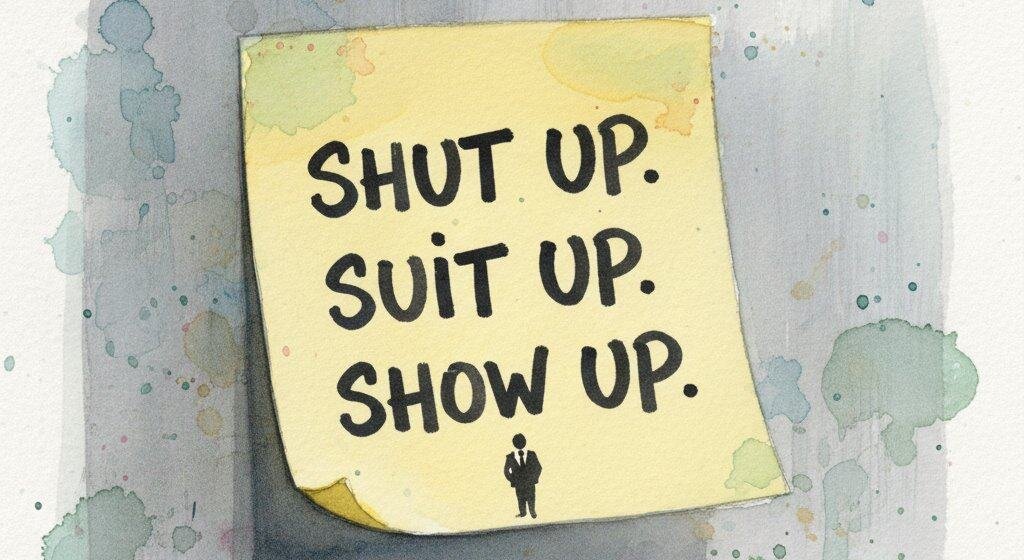
I wrote a phrase down recently and stuck it on my fridge:
“Shut up. Suit up. Show up.”
It’s blunt, and probably a bit too blunt if you’re in the middle of real grief or something heavy. But I understood why it caught my attention. Sometimes going over the same problem again and again doesn’t help much. Sometimes we need to be responsible, make an effort, and keep going with work and life even when we don’t especially feel like it.
But here’s the part I keep coming back to: where does that leave honest conversation?
This blog exists because I believe real communication matters. I don’t think people should have to swallow everything, pretend they’re fine, and keep performing until they quietly fall apart. But I also don’t think every painful feeling needs to become a full committee meeting.
Somewhere between bottling everything up and talking ourselves in circles, there has to be a better way.
How do you keep going without pretending nothing hurts?
When Talking About Pain Actually Helps
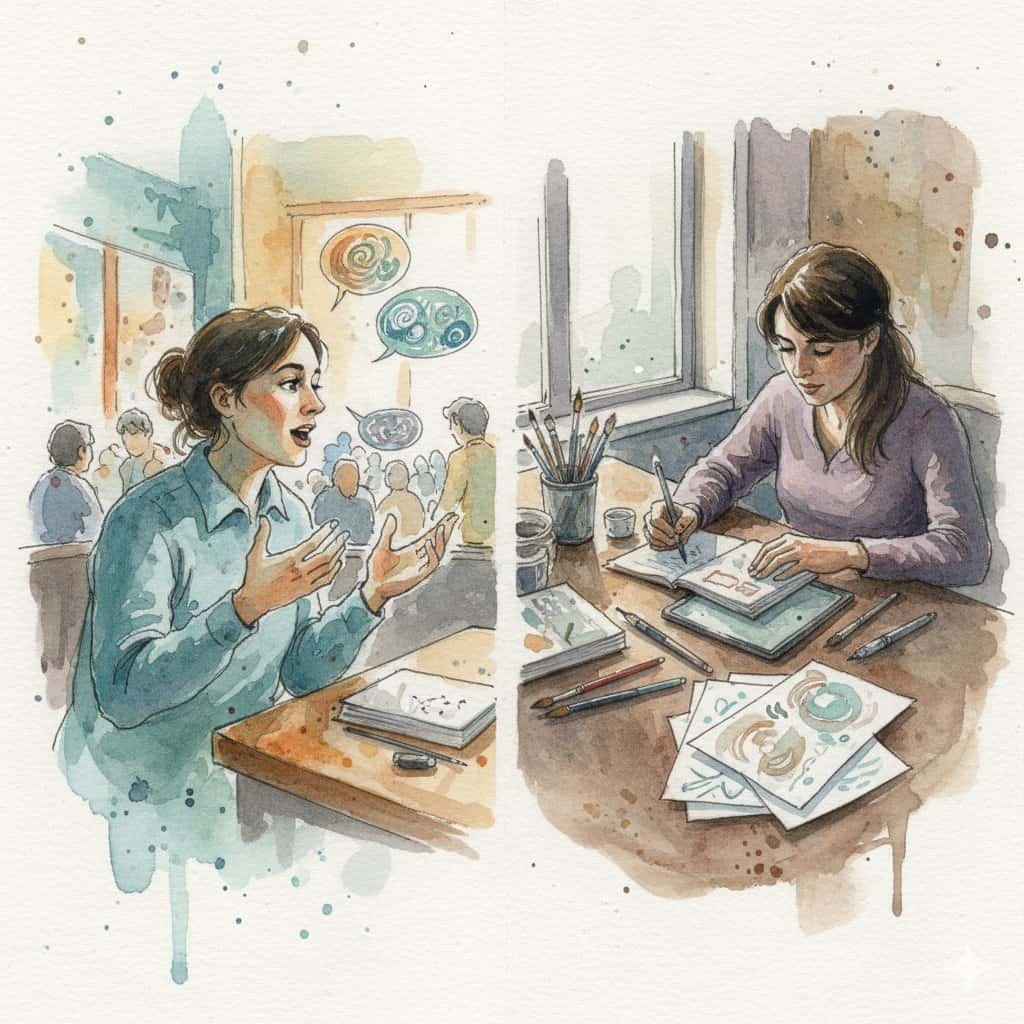
Talking helps when it does something useful.
It might help you feel less alone. It might help you understand what you’re actually dealing with. It might bring a bit of relief after carrying something by yourself for too long. Sometimes saying the thing out loud is the first moment you realise how heavy it has become.
That kind of talking matters.
It’s not weakness. It’s not self-pity. It’s not being dramatic. It’s being honest enough to stop pretending everything is fine.
Good conversations can also bring people closer. When someone listens properly, without rushing to fix you or compete with your pain, something settles. You remember that other people struggle too. You remember that you’re not the only one trying to keep functioning with a private storm going on in the background.
When has talking about pain helped you move through it?
When Talking Keeps You Stuck
But talking doesn’t always help.
Sometimes it becomes a loop. You say the same things, feel the same anger, retell the same story, and end up exactly where you started. Nothing gets clearer. Nothing softens. Nothing moves.
That’s when talking can become another way of avoiding action.
I know this one too well. Overthinking can dress itself up as honesty. Complaining can feel like processing. Going over every detail can feel productive because at least you’re doing something. But sometimes you’re just going over the same thing again and calling it progress.
The tricky part is that you don’t always know which kind of talking you’re doing until afterward. Sometimes what looks like going in circles is actually grief taking its time. Sometimes what feels like honest processing is really just feeding the same old mood.
That’s why the question isn’t simply, “Should I talk about this?”
The better question might be: “Is this helping me move through it, or helping me stay inside it?”
Where Honesty Belongs
I’ve noticed that certain places naturally allow for honest conversation, while others require speaking less and doing more.
In the work truck with my farming boss, we’re stuck together for the drive, so we have talked about his issues and mine equally. Those honest conversations release a bit of pressure. They put us on the same page, remind us what the other person is carrying, and help us work together with a bit more patience.
That works because it’s mutual. It has a natural limit. The drive ends, the talking ends, and then we get on with the job. The conversation happens alongside the work, not instead of it.
In the field or greenhouse, it’s different.
The work demands focus. There’s a productive team attitude to maintain because the job still needs doing. This is true in many workplaces. It’s not always about bottling things up. Sometimes it’s simply knowing when and where to talk. Not every moment can become emotional support, even if emotional support is something we sometimes need.

In my classroom, students sometimes open up about what they’re dealing with because the room feels safe and practising conversation naturally leads to talking about life. When it happens genuinely, it can make the connection stronger and help them learn better.
But if it turns into a therapy session, it has probably gone too far.
A couple of long-term students have told me that lessons can sometimes feel a bit like talking to a priest. I take that as a compliment. It means they feel safe enough to speak honestly. But there’s still a line: I’m their language teacher, not their therapist.
This blog is different again. It is meant to be a place for honest conversation about challenges. People can read when they’re ready, ignore it when they’re not, and share as much or as little as they want. That matters to me. I want this space to help people feel less alone, without turning pain into the only thing we ever talk about.
Where is a safe place where you can be honest about what you’re dealing with?
What Japan and the UK Taught Me About Keeping Things In

Different cultures handle struggle differently.
Some encourage people to talk openly about pain and problems. Others respect strength, privacy, and keeping things to yourself. Some families treat sharing difficulties as normal. Others treat it like weakness, drama, or unnecessary fuss.
In Japan, where I’ve lived for twenty years, people often try not to burden others with their problems. There can be kindness in that. It can be polite, considerate, and socially thoughtful.
But it can also leave people carrying too much alone.
In the UK, where I grew up, there’s the old “keep calm and carry on” attitude. That can be useful too. Life does not stop every time we feel bad. People still need feeding, work still needs doing, bills still arrive, and responsibilities do not politely wait until we feel emotionally sorted.
But that attitude can also make people feel as if admitting pain is self-indulgent or embarrassing.
Neither approach is all good or all bad. Both can help. Both can hurt.
There are times when staying strong gets you through the day. There are also times when staying strong becomes a way of disappearing from your own life.
Maybe that’s why this question is harder than it looks. We are not only deciding whether to talk or keep going. We are also dealing with our family habits, cultural background, work expectations, pride, fear, and whatever survival style we picked up years ago.
Did your family talk about problems openly, or was that something you just didn’t do?
How to Know What You Need Right Now
Maybe the real skill isn’t choosing between talking and getting on with things. It’s learning to notice what actually helps in this moment.
There are times when talking helps.
- When you’re dealing with something alone that would be easier with support.
- When you can’t see the situation clearly and need another viewpoint.
- When you’re grieving and need someone to recognise what you’re going through.
- When isolation is making the problem feel bigger than it is.
- When shame or embarrassment is eating away at you.
There are also times when showing up matters more.
- When you’re going over the same thing again and again.
- When you need to take one practical step instead of analysing everything.
- When people are counting on you to do your job or be there.
- When thinking about your problems is stopping you from doing what needs doing.
- When talking has become a way of avoiding the thing you already know you need to face.
What you need changes.
Sometimes you need to talk it through. Sometimes you need to shut up, suit up, and show up. Often you need both, just at different times.
How do you know when it’s time to talk, and when it’s time to keep moving?
Being Real Without Letting Pain Run Everything

Here’s what I’ve learned so far: making room for honest conversation doesn’t mean giving up on responsibility.
This blog encourages honest talk about challenges because I believe that matters. But I also believe in showing up after a necessary amount of time. Cycling to work even when I don’t feel like it. Teaching my classes whether I’m struggling or not. Farming because the work needs doing no matter how I’m feeling.
I’m using my own examples, but most of us have some version of this.
The “shut up, suit up, show up” mentality does not have to mean ignoring pain. At its best, it means understanding that life continues to require our effort, even when we are dealing with difficulty.
We can’t always wait until we feel ready or happy before we keep functioning. Sometimes the functioning is what helps us get through. The routine. The movement. The task in front of us. The small proof that we are still part of the world.
At the same time, we can’t only function.
We often need places and times to be honest about what we’re dealing with. To admit when we’re struggling. To talk things over with someone who can actually hear us. To acknowledge that keeping everything locked inside creates its own problems.
Maybe the point isn’t to choose one forever.
Maybe the point is to ask, honestly: what would help me today?
Do I need to speak?
Do I need to act?
Do I need to rest?
Do I need to stop explaining and take the next step?
Do I need to stop pretending and finally tell someone the truth?
How do you keep life moving while still dealing with what you’re going through?
Frequently Asked Questions About Talking, Coping, and Keeping Going
Is talking about pain always helpful?
No. Sometimes talking helps you move through something. Other times, it keeps you circling the same problem without changing anything.
Talking is helpful when it brings relief, clarity, connection, or support. It becomes less helpful when it turns into repeated complaining, overthinking, or retelling the same story without any movement.
The hard part is being honest about which one you’re doing.
How do I know if I’m processing something or just going in circles?
Processing usually brings some kind of movement, even if it’s small. You understand something better. You feel a little lighter. You see one practical step. You feel less alone.
Going in circles usually leaves you more wound up, more bitter, or more stuck than before.
That doesn’t mean grief or pain should be rushed. Some things take time. But if every conversation leaves you in exactly the same place, it might be worth asking whether talking is helping or feeding the problem.
Is it unhealthy to stay busy when life is hard?
Not always.
Staying busy can be avoidance, but it can also be structure. Work, exercise, routines, and responsibilities can help you keep going when your mind is all over the place.
The problem comes when staying busy becomes the only way you cope. If you never give yourself time to feel, think, pray, grieve, or talk honestly, the pressure may come out somewhere else.
Sometimes work helps. Sometimes rest helps. Sometimes conversation helps. The answer depends on what you’re facing and what you’re using the busyness to avoid.
How do culture and family affect the way we talk about problems?
A lot.
Some of us grew up in families where problems were discussed openly. Others learned to keep things private, stay strong, or avoid making a fuss.
Culture plays a part too. In Japan, not burdening others can be seen as considerate. In the UK, “keep calm and carry on” can still shape how people deal with difficulty.
Those habits are not automatically wrong. But they are worth noticing. Sometimes what feels like your personality is partly what you were taught.
What Has Actually Helped You?
I’m asking because I don’t have this neatly figured out.
Some people need to talk things through before they can move. Others cope by staying busy. Some need a bit of both, depending on what they’re facing and how raw it still feels.
Maybe you thought you’d be someone who talked openly, then found yourself going quiet when life got hard. Maybe you thought you’d just push through, then realised you needed someone to sit with you and hear the truth.
There probably isn’t one correct answer.
What matters is noticing what actually helps you. Not what looks strong. Not what sounds emotionally mature. Not what your family, culture, workplace, or old survival habits taught you to do.
What helps?
Talking it through?
Getting outside?
Working?
Praying?
Staying busy for a while?
Finally admitting that you’re not okay?
The way you deal with hard things might help someone else feel less strange about the way they deal with theirs.
So what do you think? When life gets heavy, do you need to talk about it, keep moving, or some mixture of both?

Related Reads on OldDogZeroTricks
- Are You Mentally Healthy or Just Good at Coping?
- It’s Okay to Be Broken
- How Small Daily Anchors Keep Us Steady

Grant here (aka OldDogZeroTricks). I’m a British expat living in Japan, teaching English, growing vegetables, and writing honestly about aging, purpose, and figuring things out – without the BS.
This blog is where I talk about the stuff most people keep to themselves – the embarrassing truths, the questions we don’t ask out loud, and what it feels like to keep going, one ordinary day at a time.